Excel Template
Manage your spreadsheet data source for automated form filling with native support for local Excel (.xlsx) files and Google Sheets integration.
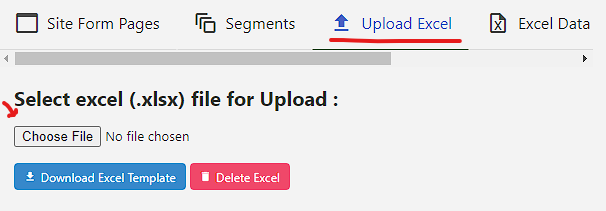
Overview
Excel templates serve as the primary data source for your automated workflows. Excellent Data Filler reads row records sequentially or randomly and fills target web form inputs accordingly.
The extension supports two Excel data source types:
- Upload Excel File: Upload local Excel (
.xlsx) files directly into extension storage for fast, offline execution. - Google Sheet (Beta): Connect to Google Sheets for real-time cloud collaboration, automatic syncing, and multi-browser automation.
IMPORTANT
Strict .xlsx Format Requirement: The extension exclusively supports .xlsx spreadsheet files. Other spreadsheet formats are not supported for uploads.
Excel Source Type Selection
Within your Site workspace, open the Upload Excel tab. Use the Excel Source Type radio toggle to select your data source:
| Source Type | Description | Best For |
|---|---|---|
| Upload Excel File | Direct upload of a local .xlsx workbook into extension storage. | Fast execution, offline workflows, standalone automation tasks. |
| Google Sheet (Beta) | Live cloud connection via Google Sheets API (OAuth2 or Service Account). | Team collaboration, real-time data entry, multi-browser distributed processing. |
Method 1: Upload Excel File
Follow these steps to upload and manage local Excel files:
Step 1: Select Upload Excel File
- Navigate to the Upload Excel tab in your site workspace.
- Select the Upload Excel File option under Excel Source Type.
Step 2: Upload Your .xlsx File
- Under Select Excel File (.xlsx) for Upload, click inside the upload box or drag and drop your file.
- Select your
.xlsxworkbook from your computer. - Click Save Excel Template to store the workbook in the extension.
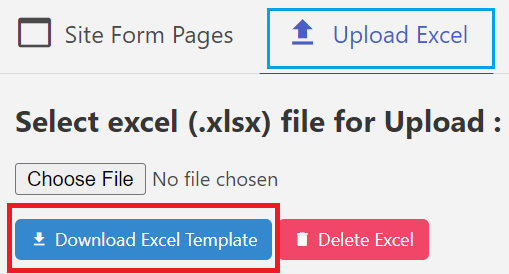
Available Toolbar Actions
| Action Button | Purpose | Details |
|---|---|---|
| Save Excel Template | Commit and save dataset | Saves the uploaded .xlsx data into local extension storage for the active site. |
| Download Excel Template | Generate .xlsx template | Creates a ready-to-fill .xlsx spreadsheet pre-populated with column headers matching your configured form fields. |
| Delete Excel (Trash Icon) | Clear uploaded data | Removes the current Excel dataset from extension storage. |
Excel Data Status States
- When No Excel File is Uploaded:text
Not Found Excel Data Not Available, Please Upload Excel File. - When Excel File is Successfully Uploaded:
- The records become immediately accessible for automation.
- You can inspect loaded rows and column mappings under the Excel Data tab.
- The extension tracks row indexes during automation runs.
Method 2: Google Sheet (Beta)
Connect directly to cloud spreadsheets in Google Drive for live data streaming and bidirectional sync.
Connection Types
Google Sheet integration supports two distinct authentication methods:
1. OAuth2 (Login Required)
Connect using your Google account via standard OAuth2 authentication.
- Requirements: Active Google account with access permissions to the target spreadsheet and an internet connection.
- Setup:
- Select the Google Sheet (Beta) radio button.
- Choose OAuth2 (Login Required).
- Click Check Account Connection.
- Follow the Google OAuth popup prompt to sign in and grant spreadsheet read/write permissions.
2. Client Service Account (No Login Required)
Connect securely via a Google Cloud Console service account without requiring browser user logins.
- Requirements:
- A Google Cloud Platform (GCP) project with the Google Sheets API enabled.
- A Service Account with an exported JSON key file containing
client_emailandprivate_key. - The Google Sheet must be shared with the Service Account email address (
Editorpermissions).
- Setup:
- Select the Google Sheet (Beta) radio button.
- Choose Client (Service Account, No Login Required).
- Click Click to Upload JSON File and select your downloaded service account
.jsonkey file. - Ensure your Google Sheet is shared with the service account email.
TIP
Service Account Sharing: Always open your Google Sheet, click Share, and paste the Service Account email (...iam.gserviceaccount.com) as an Editor to allow reading and updating rows.
Google Sheet Configuration
Required Connection Fields
| Field | Description | Example |
|---|---|---|
| Spreadsheet URL | Full web URL of the Google Spreadsheet. | https://docs.google.com/spreadsheets/d/1A2B3C4D5E6F7G8H9.../edit |
| Spreadsheet Sheet Name | Exact name of the sheet/tab containing your data (case-sensitive). | Sheet1, Orders, FormData |
| How many rows of the sheet to fetch? | Maximum number of rows to retrieve per batch. | 30, 50, 100 |
Optional Advanced Features
Fetch Sheet Row Data Using Browser ID
Enables running multiple browser instances or profiles concurrently against the same sheet without row collision.
- How it works:
- Toggle Fetch Sheet Row Data Using Browser Id.
- Enter identifier names in the Browser ID field (e.g.,
browser-1,browser-2). - In your Google Sheet, create a column named
<code v-pre>{BROWSER-ID}</code>. - Assign the appropriate browser ID value to each row.
- The extension instance will only fetch and fill rows designated for its configured Browser ID.
NOTE
The column header in your Google Sheet must be spelled exactly <code v-pre>{BROWSER-ID}</code> (including curly braces).
Ignore Column Values When Updating
Protects specific columns from being overwritten when pushing site data updates back to the sheet.
- How to use:
- Toggle Ignore column values when updating the sheet?.
- Enter the column names you wish to preserve (e.g.,
Status,Notes,DateAdded), pressing Enter after each entry. - These columns will be retained untouched during sync operations.
Google Sheet Management Actions
Check Account Connection
Tests and confirms your Google account authentication or Service Account JSON validity.
- OAuth2: Triggers authentication verification with Google servers.
- Service Account: Validates the uploaded JSON key format and cryptographic credentials.
Check Sheet Connection
Verifies network access, spreadsheet URL validity, and sheet tab existence. Confirms that headers and rows can be fetched properly.
Update Sheet With Site Data
Synchronizes your configured form fields with the Google Sheet structure.
- Inspects all form fields registered in the active site.
- Generates or updates column headers in the target sheet to match field names.
- Configures schema alignment for seamless two-way data filling and status reporting.
Clear Sheet Cache
Flushes locally cached Google Sheet data, forcing the extension to pull fresh records on the next automation cycle.
IMPORTANT
Always click Clear Sheet Cache whenever you edit cell values, insert rows, or add new columns directly inside Google Sheets.
Excel Template Download
Generating an Excel template ensures your local .xlsx file matches your form field names with 100% precision:
- Configure all form fields in your site.
- Under the Upload Excel tab, click Download Excel Template.
- The extension compiles an
.xlsxworkbook containing:- Header row matching every active field name.
- Proper column sequencing.
- Clean column layout ready for batch data entry.
- Open the downloaded file in Microsoft Excel or compatible software, populate your rows, and upload it back into the extension.
- Output File Naming Format:
[SiteName]_Template_[Date].xlsx
Prerequisites
Before uploading data or downloading templates, ensure:
- Site Created: A parent site container exists in the extension.
- Forms Registered: At least one form page is added under the site.
- Fields Configured: Form fields have assigned element selectors and field types.
- Valid Names: Field names are clear and descriptive to generate readable
.xlsxcolumn headers.
Automation Workflows
Local Excel (.xlsx) Workflow
[Configure Fields] ──> [Download .xlsx Template] ──> [Populate Rows] ──> [Upload .xlsx] ──> [Run Automation]- Download Template: Click Download Excel Template to obtain the current field schema.
- Populate Rows: Fill records into the
.xlsxsheet. - Upload Workbook: Upload via Select Excel File (.xlsx) for Upload and click Save Excel Template.
- Execute: Trigger form filling with Alt + Q or on page load.
Google Sheets Workflow
[Connect OAuth2 / Service Account] ──> [Set URL & Sheet Name] ──> [Update Sheet With Site Data] ──> [Fill Rows] ──> [Run Automation]- Authenticate: Connect using OAuth2 or upload Service Account JSON.
- Configure: Provide the Spreadsheet URL and Sheet Tab Name.
- Structure Sync: Click Update Sheet With Site Data to create headers automatically.
- Input Data: Enter data into the Google Sheet.
- Execute: Run automation. If edits are made in the sheet, click Clear Sheet Cache.
Troubleshooting
Local Excel Issues
| Problem | Cause | Solution |
|---|---|---|
| Template not downloading | Missing form fields or browser permission issue | Ensure at least one form with fields is configured. Check browser download settings. |
| Excel file will not upload | Unsupported file format or corrupted file | Ensure the file is strictly .xlsx. Re-save the file in Excel if needed. |
| Data not filling into form | Header mismatch with field names | Download a fresh template to verify column headers match field names exactly. |
Google Sheet Issues
| Problem | Cause | Solution |
|---|---|---|
| Cannot connect Google account | Expired OAuth session or network block | Re-click Check Account Connection and complete the Google login prompt. |
| Sheet connection failed | Incorrect URL, sheet name mismatch, or missing permissions | Verify the URL and tab name (case-sensitive). For Service Accounts, verify the sheet is shared with the service account email as Editor. |
| Data changes not appearing | Local cache active | Click Clear Sheet Cache to fetch the latest cloud rows. |
| Browser ID filtering not working | Header misspelling or missing column | Confirm the column header is named <code v-pre>{BROWSER-ID}</code> and row values match the configured ID. |
Best Practices
Do's
- Download Fresh Templates: Download a new
.xlsxtemplate whenever you add, rename, or remove form fields. - Match Header Names: Ensure column names match field names accurately.
- Clear Cache on Sheet Edits: Always click Clear Sheet Cache after updating Google Sheet data.
- Test with Sample Rows: Test automation on 2-3 rows before processing large datasets.
- Use Browser IDs for Scale: Use
<code v-pre>{BROWSER-ID}</code>when distributing work across multiple profiles or devices.
Don'ts
- Do Not Use Non-XLSX Formats: Upload local data exclusively in
.xlsxformat. - Do Not Rename Headers Manually: Avoid altering generated template column headers.
- Do Not Leave Formulas Uncalculated: If your spreadsheet uses complex formulas, ensure values are resolved before running automation.
- Do Not Expose Service Account Keys: Keep your Google Cloud JSON credentials safe and confidential.


